✨ New Arrivals Just Dropped!Explore


Mark I Models MKM14449 1:144 Heinkel He-219A-0/LB-79 'Flying Laboratory'
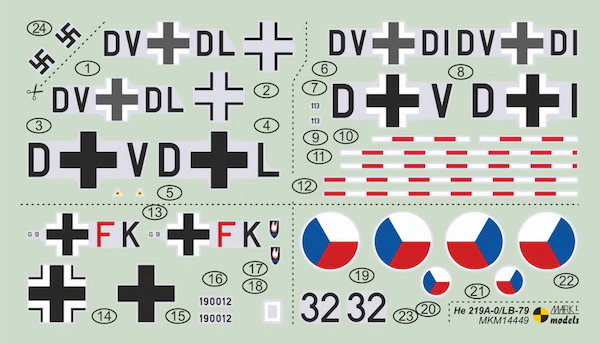
Heinkel He-219A-0/LB-79 'Flying Laboratory' (Luftwaffe, Czechoslovak AF) The He-219 Uhu was a German heavy night fighter, employing a number of the then novel radar and antennae equipment, and was the first operational HYPERLINK " http://en.wikipedia.org/wiki/Military_aircraft " \o "Military aircraft" military aircraft to be fitted with HYPERLINK " http://en.wikipedia.org/wiki/Ejection_seat " \o "Ejection seat" ejection seats. After protracted development the prototype flew in November 1942. The first fighter variant to be delivered was the He-219A-0, which was actually identical to the 'A-2'. It was equipped with four cannons in the ventral tray and two guns in the wings. The He-219A-5 was the first major production version, being similar to the previous 'A-2' model but with an extended range, while the final variant was the He-219A-7, fitted with improved engines. The He-219 was a two-seat, all-metal monoplane powered by two Daimler-Benz DB 603 in-line piston engines. Nearly 300 of all the He-219 models were built and although the type proved to be a capable fighter, it saw only limited service; had they been available in quantity, they might have had a significant effect on the strategic night bombing offensive of the Allied forces carried in the latter half of the war. After the war, a few aeroplanes were test flown by the Czechoslovak Air Force; however, their service was limited and short-lived. Colour schemes included in the kit: 1) He-219A-0, DV+DL (W.Nr. 190116), Luftwaffe, Werneuchen airfield, Germany, summer 1944 2) He-219A-0, DV+DI, Black 113 (W.Nr. 190113), Luftwaffe, Rechlin-Larz Air Base, Germany, 1943-44 3) He-219A-0/R6, G9+FK (W.Nr. 190012), 2./NJG 1, Luftwaffe, Venlo-Herongen airfield, the Netherlands, April 1944 4) LB-79 (He-219A-5), Black 32, LVš Aviation Research Institute, serving with 2nd Sq., 51st Air Regiment, Czechoslovak Air Force, Plzeň-Bory airfield, Czechoslovakia, early 1952 This injection-moulded kit contains 35 parts, one clear part (the cockpit canopy) and a small fret with 41 photo-etched parts. For modeller's convenience a display base, made of pasteboard card, depicting a section of the Luftwaffe military airfield is added. A comprehensive instruction leaflet and a decal sheet are included.
$8.07
Original: $23.05
-65%Mark I Models MKM14449 1:144 Heinkel He-219A-0/LB-79 'Flying Laboratory'—
$23.05
$8.07Product Information
Product Information
Shipping & Returns
Shipping & Returns
Description
Heinkel He-219A-0/LB-79 'Flying Laboratory' (Luftwaffe, Czechoslovak AF) The He-219 Uhu was a German heavy night fighter, employing a number of the then novel radar and antennae equipment, and was the first operational HYPERLINK " http://en.wikipedia.org/wiki/Military_aircraft " \o "Military aircraft" military aircraft to be fitted with HYPERLINK " http://en.wikipedia.org/wiki/Ejection_seat " \o "Ejection seat" ejection seats. After protracted development the prototype flew in November 1942. The first fighter variant to be delivered was the He-219A-0, which was actually identical to the 'A-2'. It was equipped with four cannons in the ventral tray and two guns in the wings. The He-219A-5 was the first major production version, being similar to the previous 'A-2' model but with an extended range, while the final variant was the He-219A-7, fitted with improved engines. The He-219 was a two-seat, all-metal monoplane powered by two Daimler-Benz DB 603 in-line piston engines. Nearly 300 of all the He-219 models were built and although the type proved to be a capable fighter, it saw only limited service; had they been available in quantity, they might have had a significant effect on the strategic night bombing offensive of the Allied forces carried in the latter half of the war. After the war, a few aeroplanes were test flown by the Czechoslovak Air Force; however, their service was limited and short-lived. Colour schemes included in the kit: 1) He-219A-0, DV+DL (W.Nr. 190116), Luftwaffe, Werneuchen airfield, Germany, summer 1944 2) He-219A-0, DV+DI, Black 113 (W.Nr. 190113), Luftwaffe, Rechlin-Larz Air Base, Germany, 1943-44 3) He-219A-0/R6, G9+FK (W.Nr. 190012), 2./NJG 1, Luftwaffe, Venlo-Herongen airfield, the Netherlands, April 1944 4) LB-79 (He-219A-5), Black 32, LVš Aviation Research Institute, serving with 2nd Sq., 51st Air Regiment, Czechoslovak Air Force, Plzeň-Bory airfield, Czechoslovakia, early 1952 This injection-moulded kit contains 35 parts, one clear part (the cockpit canopy) and a small fret with 41 photo-etched parts. For modeller's convenience a display base, made of pasteboard card, depicting a section of the Luftwaffe military airfield is added. A comprehensive instruction leaflet and a decal sheet are included.