✨ New Arrivals Just Dropped!Explore

RS Models RSMI92222 1:72 Bucker Bu-133C "Green stripe" 5 decal variants 1
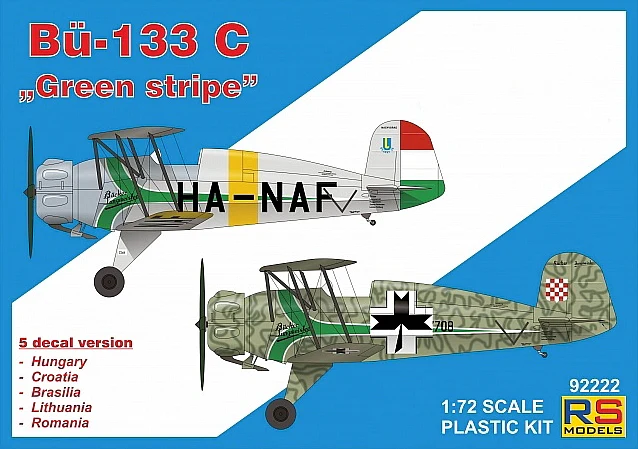
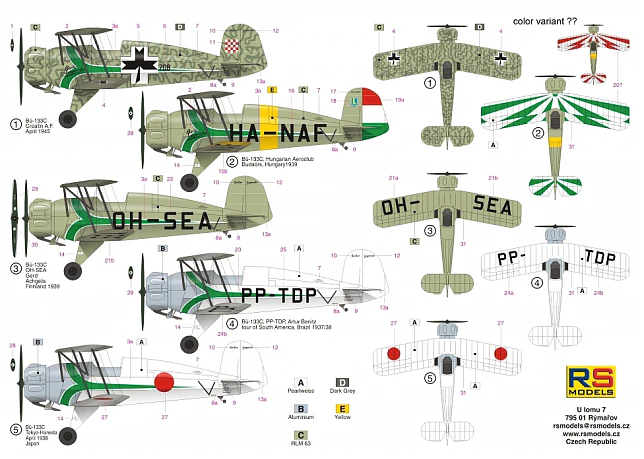
Bucker Bu-133C "Green stripe" 5 decal variants 1. Bu-133C, Croatin A.F., April 1945 2. Bu-133C, Hungarian Aeroclub, Budaors, Hungary1939 3. Bu-133C, OH-SEA, Gerd Achgelis, Finnland 1939 4. Bu-133C, PP-TDP, Artur Benitz, tour of South America, Brazil 1937/38 5. Bu-133C, Tokyo-Haneda, April 1938, Japan The Bucker Bu 133 Jungmeister was an advanced trainer of the Luftwaffe in the 1930s. It was a single-engine, single-seat biplane of wood and tubular steel construction and covered in fabric. The Bu 133 was a development of the Bucker Bu 131 Jungmann two-seat basic trainer. First flown in 1935 (by Luise Hoffmann, the first female works pilot in Germany), it was slightly smaller than the Bu 131. The prototype, D-EVEO, was powered by a 140 hp (104 k W) Hirth HM506 inverted, air-cooled inline-6 engine. The aircraft showed "astonishing agility" at its first public appearance, the 1936 International Aerobatic Championship at Rangsdorf, but the Bu 133A garnered no orders; only two Bu 133Bs, with 160 hp (119 kW) version of that same Hirth HM506 inline-6 engine, were built. The main production type was the 160 hp (119 kW) Siemens-Bramo Sh 14A radial powered Bu 133C, which had a distinctive cowling and a 13 cm (5.1 in)-shorter fuselage, and the same fine aerobatic performance as the Bu 133A.
$25.89
RS Models RSMI92222 1:72 Bucker Bu-133C "Green stripe" 5 decal variants 1—
$25.89
Product Information
Product Information
Shipping & Returns
Shipping & Returns
Description
Bucker Bu-133C "Green stripe" 5 decal variants 1. Bu-133C, Croatin A.F., April 1945 2. Bu-133C, Hungarian Aeroclub, Budaors, Hungary1939 3. Bu-133C, OH-SEA, Gerd Achgelis, Finnland 1939 4. Bu-133C, PP-TDP, Artur Benitz, tour of South America, Brazil 1937/38 5. Bu-133C, Tokyo-Haneda, April 1938, Japan The Bucker Bu 133 Jungmeister was an advanced trainer of the Luftwaffe in the 1930s. It was a single-engine, single-seat biplane of wood and tubular steel construction and covered in fabric. The Bu 133 was a development of the Bucker Bu 131 Jungmann two-seat basic trainer. First flown in 1935 (by Luise Hoffmann, the first female works pilot in Germany), it was slightly smaller than the Bu 131. The prototype, D-EVEO, was powered by a 140 hp (104 k W) Hirth HM506 inverted, air-cooled inline-6 engine. The aircraft showed "astonishing agility" at its first public appearance, the 1936 International Aerobatic Championship at Rangsdorf, but the Bu 133A garnered no orders; only two Bu 133Bs, with 160 hp (119 kW) version of that same Hirth HM506 inline-6 engine, were built. The main production type was the 160 hp (119 kW) Siemens-Bramo Sh 14A radial powered Bu 133C, which had a distinctive cowling and a 13 cm (5.1 in)-shorter fuselage, and the same fine aerobatic performance as the Bu 133A.